
Native sunflowers are wonderful. They just aren’t bioremediation.

Updated: Feb 9
Written by Sara G. Marti of Resilient Palisades
Based on research by Dr. Danielle Stevenson, PhD, as presented in Briefing on Bioremediation Studies in Los Angeles County (Centre for Applied Ecological Remediation)
February 2026
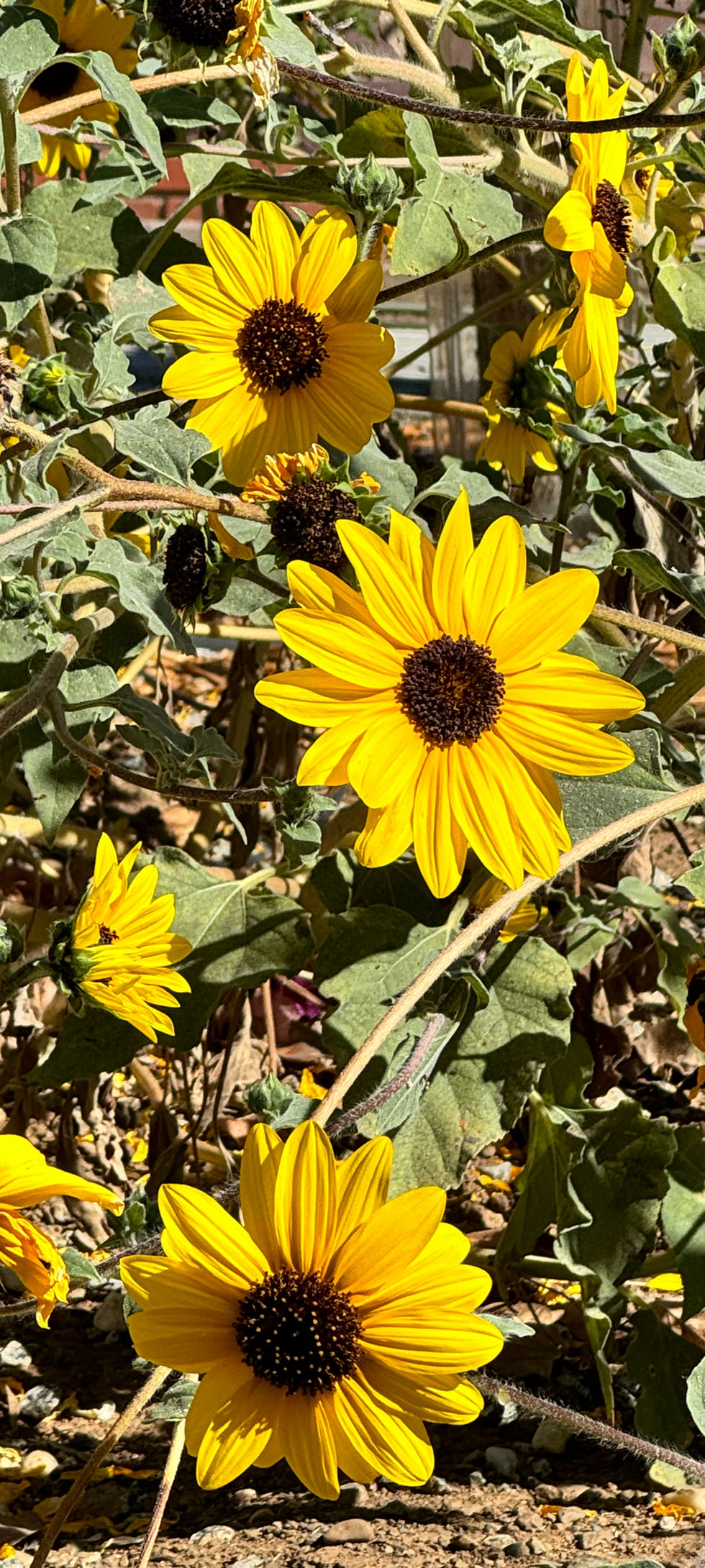
Native sunflowers bring real joy to a landscape. And honestly, they should be planted for that reason alone. They grow fast, feed pollinators, help hold soil in place, and make damaged land feel alive again. After a fire or any big disruption, that emotional lift is not small. Sometimes a bright yellow flower is doing plenty of work already.
But when we say planted for joy “alone,” we mean it.
Planting native sunflowers by itself is not bioremediation.
That distinction is not academic. It’s about safety, public health, and being straight with people.
According to the research of Dr. Danielle Stevenson (environmental toxicology, CAER), bioremediation is a complex, science-based process. It is not the same thing as gardening, revegetation, or beautification. Her work consistently draws a clear line between planting for visual beauty and remediation designed to deal with contamination in soil.
That work is being carried forward through the Fire-Resilient Bioremediation and Landscape Recovery Consortium, convened by Resilient Palisades alongside scientific and community partners like Eaton Fire Residents United. Dr. Stevenson contributes as a scientific and technical lead through the Centre for Applied Ecological Remediation (CAER), helping set clear standards around what bioremediation actually is and what it is not.
There’s also an important conservation to layer in. Even native plants do not belong everywhere. Fire-adapted landscapes already contain seed banks suited to their specific soils, moisture levels, and ecologies. Well-intended planting after fires can sometimes disrupt recovery rather than help it. Conservation groups often caution against scattering seeds, even native ones, without ecological guidance, because it can crowd out other species, alter habitat balance, or introduce plants into places they do not naturally thrive.
Sunflowers, for example, may flourish along trails or disturbed edges but cause harm in wetter zones like riparian areas, where they can suppress other seedlings and undergrowth. Native does not automatically mean appropriate for every place.
What bioremediation actually is
Bioremediation means living systems working together. Plants, fungi, and microbes acting as a team to deal with contamination in soil.
Plants do not work alone. Their roots are in constant conversation with fungi and bacteria underground. That hidden network is where most of the real work happens. The part we don’t see is doing the heavy lifting. Typical.
In her field studies across Southern California brownfields, Dr. Stevenson shows that:
Plants can pull metals like lead, arsenic, chromium, copper, and nickel into their tissues only when the right soil biology and chemistry is present.
Fungi are essential. Arbuscular mycorrhizal fungi help plants survive contaminated soil and may increase metal uptake. Other fungi, like Pleurotus ostreatus, actively break down organic contaminants like petroleum compounds and PAHs.
Microbes finish the job by transforming and stabilizing contaminants in the soil.
This combined approach is called phyto-mycoremediation. It is slow. It is deliberate. It is monitored. It is confirmed through rigorous testing. This is not a weekend project with a shovel and good intentions. It usually takes many months to more than a year, depending on contamination levels.
Why sunflowers alone are not enough
Native sunflowers can absorb some metals. That’s real. That’s why they can play a role in a research-guided remediation system.
But on their own, sunflowers do not clean contaminated soil enough to make it safe. Research shows they do not reliably pull lead out of the soil unless extra chemicals are added, helpful fungi are included, or the plants are genetically changed. In real soils, especially after fires or in cities, planting sunflowers alone does not lower heavy metal risk. (source)
There are real limits to what plants can do by themselves:
Roots only go so deep and therefore only potentially cleanup what they can reach. Metal uptake depends on soil chemistry, fungi, and moisture. High contamination takes time. Especially lead. Lead is stubborn. Without fungi and microbes, plants may survive just fine and still not remediate anything.
Planting sunflowers without testing, design, or follow-up can give people a false sense of safety.
Yellow petals do not cancel out heavy metals. If only.
The part people often miss. Disposal.
This is one of the most important points in Dr. Stevenson’s research, and it gets skipped a lot.
When plants are used in bioremediation, they become contaminated - if the remediation was successful.
That plant material cannot go in green bins. It cannot be composted. It should not go into regular landfill waste like yard clippings.
Those plants may have absorbed heavy metals into their tissues. If they are chipped, composted, or dumped casually, the contamination just spreads again. That’s not cleanup. That’s a boomerang.
Proper bioremediation plans include clear testing and handling protocols, protective equipment, designated disposal pathways, and often trained crews with HAZWOPER certification.
This is why bioremediation is not decorative. It is environmental cleanup.
Where native sunflowers do belong
Dr. Stevenson’s work strongly supports using native plants in the right context.
Native sunflowers are excellent for erosion control, pollinator support, soil stabilization, landscape recovery after cleanup, holding strategies while sites wait for remediation, and public spaces where contamination is low and monitored.
They are a gift to damaged land. Just not a cleanup tool on their own.
The takeaway
Planting native sunflowers is a beautiful and meaningful act.
Calling that bioremediation is inaccurate and can be unsafe.
Real bioremediation, as shown in Dr. Danielle Stevenson’s research across Los Angeles County, requires testing first, plants plus fungi plus microbes, time, monitoring, and careful handling of contaminated plant material at the end.
When we’re honest about that difference, we protect people, land, and trust. And we still get to enjoy the sunflowers.
We share honest updates on post-fire soil safety, bioremediation, and community recovery. Subscribe to our newsletter to stay informed as this work moves forward.
Primary source
Stevenson, Danielle, PhD. Briefing on Bioremediation Studies in Los Angeles County. Centre for Applied Ecological Remediation (CAER).
Peer-reviewed source
Stevenson, D. et al. “Soil drivers of fungal, bacterial and plant diversity in contaminated Southern Californian sites.” New Phytologist.https://nph.onlinelibrary.wiley.com/doi/10.1111/nph.14907


