
Restoration in Action
Since the Palisades Fire, Removal of Invasive Plants has grown from a small local effort into an active community restoration program. Led by Jordan Corral, our team has worked across Pacific Palisades and beyond, removing invasive vegetation, protecting recovering native plants, preventing seed spread, restoring habitat and bringing hundreds of community members into the work.

Removal of Invasive Plants partnered with local Scouts for hands on ecological restoration, removing invasive vegetation and making space for native plants to recover in Pacific Palisades.
At Temescal Canyon Gateway Park, our team has removed thousands of gallons of invasive vegetation from hillsides, trails, green spaces and waterways. We have tackled major infestations of castor bean, fennel, black mustard, fountain grass, pampas grass, tree tobacco, mimosa, Cape ivy and other invasive species.
But pulling plants out of the ground is only part of the job.
When enormous stands of castor bean began producing seed, our team shifted its attention to stopping the next generation before it could spread. Volunteers cut and collected bags of seed clusters, and across subsequent restoration days, hundreds of pounds of invasive seed were removed before rain and wind could carry it farther into the watershed.
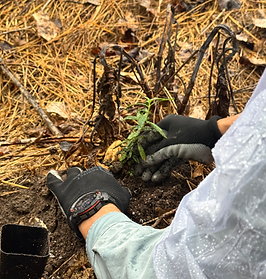
We are also putting native plants back.
After clearing heavily invaded areas at Temescal, volunteers began planting California native species including California mugwort, evening primrose, sticky monkeyflower, California buckwheat, western columbine and yerba buena. Existing native plants are carefully protected during removal. When we found a recovering California sycamore crowded by invasive mimosa, volunteers cleared the competing vegetation around it and gave the tree room to recover.
The goal is not bare ground. It is a functioning native ecosystem.
And the work reaches far beyond Temescal.
At the Twelve Trees Memorial beside Palisades High School, RIP has brought together students, families and community partners for repeated restoration days. One volunteer event with Heal the Bay brought 30 people into the field. Another youth led effort removed 27 full 55 gallon bags of invasive plant material in a single day.
At the Rotary site at Temescal Canyon Road and Pacific Coast Highway, an Eagle Scout project brought together RIP, local Scouts and the Rotary Club of Pacific Palisades to clear invasive vegetation and give native plants room to recover.
At Bowdoin Garden, 13 Palisades High School students worked alongside RIP and Palisades Beautiful to remove twelve 55 gallon bags of invasive vegetation and plant native species in the newly opened spaces.
We have worked with Palisades Charter High School, St. Matthew’s Parish School, New Roads School, the Palisades YMCA Youth & Government program, the YMCA Teen Advisory Council, local Scouts, Palisades Beautiful, Heal the Bay, Climate Action Corps volunteers and other community partners to restore spaces throughout the Palisades.
We have also helped residents directly. Following the fire, RIP began providing brush clearance and invasive plant removal for local properties, including burned lots, rebuilding sites and standing homes. By early summer alone, the team had already served more than 20 properties. Rather than indiscriminately clearing vegetation, we identify and preserve native and fire adapted plants wherever possible.
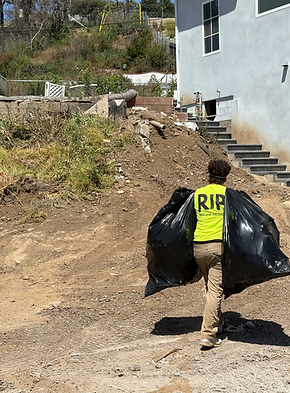

At the TREEAMS property, for example, our team began a long term effort to remove an extensive Algerian ivy infestation, taking out multiple 55 gallon bags during the first phase alone and returning to address regrowth.
RIP joined California State Parks, the California Native Plant Society, Reseda High School and the Reseda Police Academy for restoration along the Santa Ynez Canyon trail.
About 35 students and 10 adults worked together removing invasive tree tobacco, castor bean and Cape ivy while learning how to distinguish invasive vegetation from the native plants growing around it.
That is an especially good example because it combines field restoration and education.

RIP joined California State Parks, the California Native Plant Society, Reseda High School and the Reseda Police Academy for a restoration day at Santa Ynez Canyon, where 35 students and 10 adults helped remove invasive plants and learn how to protect native habitat.
Field Mentorship Across Los Angeles
RIP Team Lead Jordan Corral regularly works in the field with Bill Neill, president of the Los Angeles/Santa Monica Mountains Chapter of the California Native Plant Society and a professional invasive plant specialist with roughly four decades of experience controlling invasive species in Southern California. Neill has worked extensively in coastal watersheds, the California desert and natural areas throughout the region, and has helped lead invasive plant management efforts for decades.
Together, Jordan and Bill have worked at sites across Los Angeles identifying and removing invasive species including star thistle, castor bean, black mustard and others while protecting native vegetation.
Building a Community That Knows What to Do
The long term solution cannot depend on one crew pulling weeds.
That is why education has become an important part of RIP’s work. We have hosted community webinars on invasive plants, native plants and wildfire recovery, created educational brochures and field resources, taught residents how to recognize priority invasive species, and used our restoration events as hands on opportunities for young people and adults to learn what ecological restoration actually looks like.
Young people have become an especially important part of this work. High school students, YMCA youth leaders and Scouts have repeatedly returned to restoration sites, learning to identify invasive and native plants while helping rebuild the landscape they grew up in.
Every bag removed, seed collected, native planted, student trained and resident reached is one piece of a much larger effort.
We are not simply removing weeds. We are building the people, knowledge and infrastructure needed to care for this landscape for years to come.
Our Work Reaches Beyond the Palisades
What RIP has learned in Pacific Palisades is increasingly being applied elsewhere. Our team has joined restoration projects across Southern California, working alongside researchers, public agencies, conservation organizations, schools and local communities confronting many of the same challenges.
Upper Santa Clara River
RIP Team Lead Jordan Corral identified priority Arundo sites along the Upper Santa Clara River, secured right of entry from private landowners so researchers could access them, and helped install and monitor sensors measuring water use in Arundo and native riparian plants.
The work is being carried out with researcher Tom Dudley and regional partners as part of a larger effort to understand and manage the impacts of Arundo across the watershed.
This is especially valuable because it gives RIP firsthand experience with what happens when an invasive plant problem grows from scattered populations into a watershed scale restoration challenge.
Regan Ranch, Malibu Creek State Park
At Regan Ranch in Malibu Creek State Park, RIP joined California State Parks to remove yellow star thistle and target onion weed, an invasive species being watched closely because it has not yet become widely established across the Santa Monica Mountains.
The work focused on early intervention. Removing emerging invasive populations before they spread can prevent a small problem from becoming a much larger restoration challenge later.
Santa Rosa Island
RIP crew members spent multiple days on Santa Rosa Island supporting post fire ecological restoration after a wildfire burned approximately 16,000 acres.
The work brings our team into a very different landscape but addresses the same fundamental challenge we face at home: helping native ecosystems recover after major disturbance before invasive species gain more ground.
Pasadena
RIP was called to help assess and restore a fire affected hillside in Pasadena where invasive vegetation had rapidly filled disturbed areas after the Eaton Fire.
The site contained castor bean, black mustard, fountain grass, tree tobacco and dodder alongside surviving native plants including California bluebells and lupine. The work required careful removal of invasive vegetation without destroying the native plants recovering underneath.
Big Tujunga Canyon
At the invitation of Dr. Lara and LA Works, RIP joined restoration work in Big Tujunga Canyon. Jordan Corral and Aleksandar Pavlovic helped remove more than 100 invasive castor bean plants that were crowding native vegetation.
The group then planted 150 California native buckwheat and sagebrush plants, helping move the site from removal into actual habitat recovery.


RIP joined Dr. Lara, LA Works and community volunteers in Big Tujunga Canyon, where the group removed invasive castor bean and planted 150 California native buckwheat and sagebrush plants.
Sepulveda Basin
RIP joined Friends of the LA River and volunteers at the Sepulveda Basin Wildlife Reserve to remove old and new growth of black mustard.
The goal was to open space for native milkweed and other native plants to expand into areas previously dominated by mustard.
Westwood Greenway
RIP partnered with the Westwood Greenway and New Roads School for a hands on restoration and environmental education project.
Thirteen students helped remove invasive cheeseweed, sow thistle, bamboo, torpedo grass and golden rain tree sprouts while learning about biodiversity, water conservation and wildfire resilience.

