Green Tip: The Hidden Costs of Artificial Turf
The Palisadian-Post has partnered with locally founded environmental organization Resilient Palisades to deliver a “green tip” to our readers in each newspaper. This edition’s tip was written by Valeria Serna, a member of the Plant-Based Solutions, Zero Waste and Water Sages teams.
Artificial turf—often seen as a low-maintenance solution for sports fields and playgrounds—comes with significant environmental and health concerns.
While its typical lifespan is eight to 15 years, in coastal areas like Pacific Palisades, exposure to marine salinity and sun can drastically shorten this period, leading to frequent replacements and hidden costs.
In addition to environmental impacts such as the heat island effect, methane emissions, microplastics in air and water, non-recyclability, soil deterioration, and flame retardants, there are serious human health hazards. These include increased heat stroke, bacterial infections and exposure to cancer-causing PFAS, which then enter our air and water cycles. Current water filtration systems, whether municipal or home based, struggle to filter these particles out of our drinking water.
Recent EPA findings state that no levels of PFAS are safe. Estimates suggest that, between our water and food, each of us consumes up to five grams of plastic weekly—roughly the volume of a credit card.
Artificial turf has been shown to cause more injuries to recreational users, including leg, ankle and foot injuries, as well as burns. The surface of artificial turf can heat up to 37 degrees hotter than asphalt and 86.5 degrees hotter than natural turf grass. Anything over 120 degrees Fahrenheit can cause skin burns within seconds of contact.
Without regular watering, the soil beneath artificial turf becomes compacted and as hard as concrete, increasing the risk of injuries. Many major league sports are switching to natural grass.
Beyond chemical exposures, critics say the material also emits high levels of methane, a potent greenhouse gas, and sheds microplastics and other chemicals into waterways.
Artificial turf can act as a heat island, increasing playing field temperatures to as much as 93°C (200°F). National Football League players pressured the league in 2022 to ban artificial turf because of injuries, and the U.S. national soccer teams will only play on natural grass for the same reason.
Artificial turf is an impervious surface, meaning it prevents water from infiltrating the soil, which is crucial for recharging aquifers. Given we are entering La Niña we should do all we can to capture water.
This year, the Palisades experienced 12 inches of rain in 24 hours. According to studies, one inch of rain on an acre of impervious surface generates 27,000 gallons of stormwater, equivalent to runoff from 20 acres of grassland. Natural grass fields, on the other hand, can reduce stormwater management needs by a ratio of approximately 30:1, significantly cutting down on runoff.
Cooling and cleaning artificial turf with potable water is not cost effective, given the ecological negative impacts. Additionally, municipal water facilities like Hyperion Water Reclamation cannot filter out PFAS (see May 23 Green Tip), meaning these harmful chemicals persist in our waterways for generations. This poses long-term health risks and environmental damage.
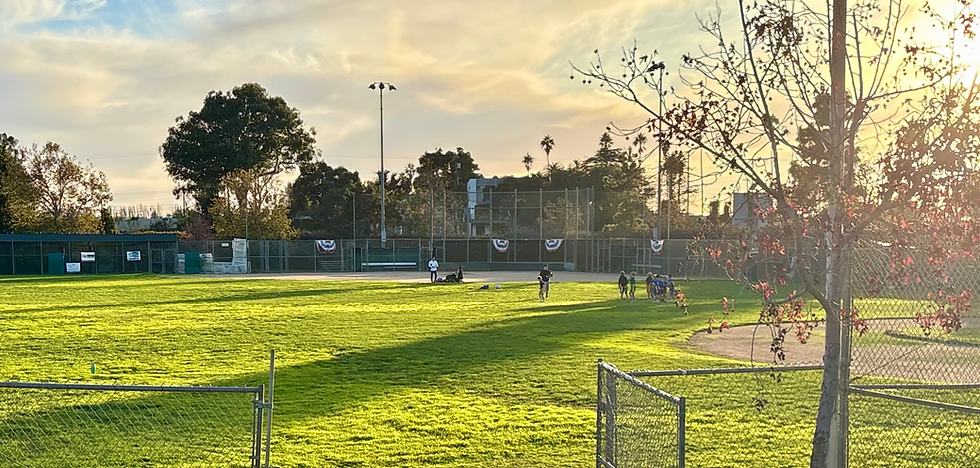
Fields with natural turf grass, managed organically, can collect, filter and store stormwater, serving as a vital piece of stormwater management. In contrast, artificial turf contributes to urban tree canopy die-off, exacerbating heat and air quality issues.
Given these significant concerns, it’s imperative that we move away from artificial turf and toward drought-tolerant, CA-friendly landscapes. AB 1572, recently signed into law, supports this shift by promoting the conversion of nonfunctional turf to native vegetation.
Let’s prioritize the health of our community and environment by supporting initiatives that foster sustainable, healthy landscapes. For more information, visit safehealthyplayingfields.org.