
Southern California Native Plants Through Our Lens
California native plants are beautiful, diverse and adapted to the landscapes we live in.
These photographs were taken by Sara G. Marti in Southern California while removing invasive plants. They feature native plants we have encountered in the field, restoration sites and surrounding natural areas.
This is not a complete native plant list or a one size fits all planting guide. It's just a growing visual guide to some of the plants that make our local ecosystems special and worth protecting. Visit Calscape.org to see a full list of native plant appropriate for your area.
Southern California includes very different plant communities, from the coast and chaparral to inland valleys and desert. A plant can be native to our region without being appropriate for every site, so planting choices should reflect local soil, sun, water and habitat conditions.

Thick Leaf Yerba Santa (Eriodictyon crassifolium) flowering in a Southern California landscape, with a native cottonwood in the background.
Apricot Mallow
Sphaeralcea ambigua
Apricot mallow is a desert native with soft gray green foliage and bright orange flowers. It is especially useful in hot, dry landscapes where you want long lasting color without much water.
Planting: Full sun, excellent drainage and very low water once established. Give it room to spread naturally and avoid heavy irrigation.

Bigberry Manzanita
Arctostaphylos glauca
Bigberry manzanita is a substantial chaparral shrub or small tree with smooth red bark, pale foliage, urn shaped flowers and large berries. It provides year round structure and habitat value.
Planting: Full sun, fast draining soil and little to no summer irrigation once established. Give it plenty of room and avoid constantly wet soil.

Black Sage
Salvia mellifera
Black sage (culinary delight) is one of the defining shrubs of Southern California coastal sage scrub and chaparral. Its pale flowers are heavily used by pollinators, and its aromatic foliage gives a landscape a distinctly local character.
Planting: Full sun, excellent drainage and low water. It performs best when allowed to follow a fairly dry summer cycle.

Bristly Fiddleneck
Amsinckia tessellata
Bristly fiddleneck is a native annual wildflower with curled clusters of yellow to orange flowers. It is valuable as part of native wildflower habitat.
Planting: Best treated as a seasonal wildflower in dry, sunny naturalistic areas. Let it reseed where appropriate.

Desert Bluebell
Phacelia campanularia
California bluebell, also called desert bluebell, produces remarkably vivid cobalt to purple flowers. It is primarily a desert species rather than a coastal Los Angeles native.
Planting: Grow from seed in full sun with very well drained soil. It is an annual and usually performs best with winter rainfall followed by dry conditions.
This photo was taken by Jordan Corral.

California Brittlebush
Encelia farinosa
Brittlebush has silvery foliage and bright yellow daisy flowers, making it a striking choice for very dry landscapes. It is particularly at home in desert and hot inland conditions.
Planting: Full sun, excellent drainage and very little supplemental water.

California Buckwheat
Eriogonum fasciculatum
California buckwheat is one of the workhorses of Southern California native landscapes. Its masses of flowers support pollinators, then age into attractive rust colored seed heads.
Planting: Full sun, good drainage and low water once established. Give it enough space for its naturally broad form rather than trying to keep it tightly clipped.

California Sunflower
Helianthus annuus
California sunflower is a fast growing native wildflower with large yellow blooms that provide food for bees, butterflies, birds and other wildlife. It grows naturally in open, sunny areas and can be especially useful in disturbed landscapes, where it establishes quickly and provides habitat while other native plants recover.
Planting: Full sun, well drained soil and low water once established. It is an annual that readily reseeds, allowing it to return year after year when conditions are right.

California Flannelbush
Fremontodendron californicum
California flannelbush (my favorite) can become a large, spectacular shrub covered with rich yellow flowers. It is dramatic enough to serve as a major landscape feature.
Planting: Full sun and extremely good drainage. Avoid regular summer irrigation once established. The fine hairs on the plant can irritate skin and eyes, so place it away from heavily used paths.

California Poppy
Eschscholzia californica
California poppy needs very little introduction, but it earns its place here. The flowers provide intense spring color while the plant thrives under the same dry seasonal conditions that define much of California.
Planting: Sow directly in sunny, well drained soil in fall. Avoid rich soil and excessive irrigation.

California Sagebrush
Artemisia californica
California sagebrush is one of the defining plants of Southern California coastal sage scrub. Its soft gray green foliage is highly aromatic, and its fine textured leaves give native landscapes a loose, natural appearance. It also provides important habitat structure for wildlife.
Planting: Full sun, well drained soil and very low water once established. Give it room to develop its naturally open form and avoid frequent summer irrigation.

Yellow Pincushion
Chaenactis glabriuscula
Yellow pincushion is a delicate California annual with small rounded yellow flower heads. It is more appropriate for native wildflower areas and restoration planting than a highly manicured garden.
Planting: Sow in open, sunny soil and allow it to complete its natural annual cycle and reseed.

Chaparral Yucca
Hesperoyucca whipplei
Chaparral yucca is one of Southern California's most dramatic native plants, with a dense rosette of rigid leaves followed by an enormous flowering stalk.
Planting: Full sun, very fast drainage and minimal irrigation. The leaves are extremely sharp, so keep it well away from sidewalks, play areas and narrow paths.

Common Cryptantha
Cryptantha intermedia
Common cryptantha is a small native annual with rough foliage and tiny white flowers. It is a natural part of chaparral and woodland plant communities. It's a plant to appreciate rather than a major landscape recommendation.
Planting: Best in dry naturalistic areas where annual natives are allowed to reseed.

Desert Wishbone Bush
Mirabilis laevis
Desert wishbone bush is a low native perennial with pink to purple flowers. Different varieties occur across desert, coastal sage scrub and chaparral habitats.
Planting: Full sun to light shade and well drained soil. Choose locally appropriate material because this species includes several geographically distinct varieties.

Hooker's Evening Primrose
Oenothera elata ssp. hookeri
Hooker’s evening primrose is a tall California native perennial with large yellow flowers that open in the evening. It naturally occurs in coastal sage scrub, chaparral and riparian habitats, including Los Angeles and Ventura counties.
Planting: Best in sun to partial sun with more moisture than many of the dry chaparral plants on this page. It can reach several feet tall, so give it room toward the back of a planting area. It is especially well suited to places that retain some seasonal moisture.

Giant Woollystar
Eriastrum densifolium
Giant woollystar produces clusters of lavender to blue flowers above narrow foliage and is native to California and the broader Southwest.
Planting: Sunny, open conditions with good drainage. It is better suited to naturalistic native plantings than heavily irrigated garden beds.

Fourwing Saltbush
Atriplex Canescens
Fourwing Saltbush is a silvery drought adapted shrub well suited to dry inland and desert landscapes. The unusual four winged fruits give the plant its name.
Planting: Full sun, excellent drainage and very low water. It is particularly useful where heat, drought or alkaline conditions make other plants difficult to grow.

Chuparosa
Justicia californica
Chuparosa is a desert shrub with vivid red tubular flowers that are highly attractive to hummingbirds. Its open green stems give it a striking sculptural appearance even when it is not fully leafed out.
Planting: Full sun, heat and extremely good drainage. Best suited to desert or very warm inland landscapes rather than the immediate coastal zone.

Succulent Lupine
Lupinus succulentus
Succulent lupine is a showy native annual with lush palmate leaves and tall spikes of blue and purple flowers. It is particularly striking when it grows in large colonies after winter rains and provides food for native bees and other pollinators.
Planting: Full sun. Unlike many dryland lupines, it tolerates heavier soils and some seasonal moisture. Sow seed in fall and allow plants to complete their annual cycle and reseed naturally. All parts should be considered toxic if eaten.

Coulter's Lupine
Lupinus sparsiflorus
Coulter’s lupine, also called Mojave lupine, is a Southern California native annual with narrow, fingerlike leaves and blue to purple flowers that can deepen or develop pink tones as they age. It grows naturally in open, rocky and sandy areas, washes, foothills and desert scrub.
Planting: Full sun and fast draining soil. Sow in fall and let winter rains bring it up naturally. Like other annual lupines, it completes its life cycle as conditions dry and can return from seed in following years.

Matilija Poppy
Romneya coulteri
Matilija poppy is one of Southern California's most dramatic native perennials, with enormous white flowers and yellow centers.
Planting: Full sun, room to spread and excellent drainage. Once established it can travel aggressively underground, so plant it where expansion will not become a problem.

Purple Nightshade
Solanum umbelliferum var. xanti, often listed as Solanum xanti
Purple nightshade is a chaparral native with violet flowers and a long flowering season. It can be a beautiful habitat plant, but all parts should be treated as toxic.
Planting: Sun to partial shade, good drainage and low water. Place it where children and pets are unlikely to ingest berries or foliage.

Purple Sage
Salvia leucophylla
Purple sage is a large aromatic shrub with soft gray foliage and pale lavender flower whorls. It gives landscapes the color and structure people often seek from Mediterranean ornamentals while belonging to Southern California's native plant communities.
Planting: Full sun, excellent drainage and low water.
Could replace: Pride of Madeira where the desired effect is a substantial gray green shrub covered with purple flowers. Pride of Madeira can escape cultivation along the California coast.

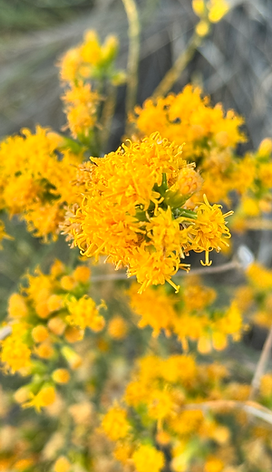
Rubber Rabbitbrush
Ericameria nauseosa
Rubber rabbitbrush is an inland native shrub that produces masses of yellow flowers late in the season. It is especially valuable in dry, open landscapes.
Planting: Full sun and low water. It is better suited to inland, desert edge and higher elevation conditions than a humid coastal garden.

Sacred Thorn Apple
Datura wrightii
Sacred thorn apple is a spectacular native perennial with enormous white trumpet shaped flowers. It is ecologically interesting and visually beautiful, but every part of the plant is poisonous if eaten.
Planting: Full sun, open soil and relatively dry conditions. This as a native plant to know rather than a general recommendation for homes with children or pets.

Scalebroom
Lepidospartum squamatum
Scalebroom is a native shrub with slender green stems and yellow flowers, particularly associated with washes and dry inland landscapes.
Planting: Full sun, fast drainage and low water. Give it space for its naturally open form.
Could replace: Spanish broom. The visual relationship is unusually strong, but Spanish is a high rated invasive by Cal IPC and can form dense stands that exclude native vegetation.
Scarlet Monkeyflower
Erythranthe cardinalis, formerly Mimulus cardinalis
Scarlet monkeyflower has brilliant red tubular flowers and naturally favors places with more moisture than most chaparral natives. It is particularly attractive to hummingbirds.
Planting: Sun to partial shade with consistent moisture, especially near seasonal drainage, seeps or irrigated native gardens.

Telegraph Weed
Heterotheca grandiflora
Telegraph weed is a tall California native that naturally appears in disturbed ground, roadsides and recently cleared areas. Its yellow flowers support pollinators, while its ability to establish quickly in damaged soils makes it especially interesting for ecological recovery.
Dr. Danielle Stevenson of the Centre for Applied Ecological Remediation calls telegraph weed a “solar powered vacuum cleaner,” referring to its potential role in ecological remediation. Plants and the microbial communities around their roots can take up, stabilize or help break down contaminants in soil.
Planting: Full sun and open soil. Telegraph weed is particularly well suited to restoration and disturbed landscapes rather than highly manicured gardens. It can grow quickly and become quite large, so give it room.

Wooly Bluecurls
Trichostema lanatum
Woolly bluecurls is an extraordinary chaparral shrub with fuzzy violet blue flowers and intensely aromatic foliage.
Planting: Full sun, extremely good drainage and minimal summer irrigation. It is best for gardeners willing to give a chaparral plant the dry conditions it wants.

White Sage
Salvia apiana
White sage is a large silver leaved native sage of Southern California and northern Baja California. Its tall flower stalks are heavily visited by pollinators.
Planting: Full sun, excellent drainage and very low summer water once established. Give mature plants generous space.

Wild Cucumber
Marah macrocarpa
Wild cucumber is a vigorous native vine that emerges during the rainy season and climbs over surrounding vegetation before going dormant as conditions dry.
Planting: Best in naturalistic areas where it has substantial room to climb and disappear seasonally. It grows from a very large underground root and is not a tidy evergreen garden vine.
Could replace: English ivy when the goal is native seasonal climbing vegetation rather than year round evergreen coverage.
English ivy is a High rated invasive that suppresses native understory regeneration.


Yarrow
Achillea millefolium
Yarrow (Achillea millefolium) photographed in Southern California. Flower color varies considerably among cultivated selections.
Yarrow is a versatile native perennial with fernlike foliage and broad clusters of small flowers. It can function as a pollinator plant, meadow plant or spreading ground layer.
Planting: Full sun to partial shade and low to moderate water. It tolerates a wider range of garden conditions than many chaparral natives and can spread gradually by underground stems.

Thickleaf Yerba Santa
Eriodictyon crassifolium
Thickleaf yerba santa is a Southern California native evergreen shrub with aromatic, toothed leaves and clusters of pale lavender flowers.
The flowers attract bees and other pollinators, while its dense foliage provides structure and cover in chaparral and other dry native plant communities.
I personally love to collect the leaves and make tea with them. It's known to soothe a sore throat.
Planting: Best in full sun with well drained soil. Once established, it needs little supplemental water and is well suited to naturalistic, drought adapted landscapes. It spreads by underground rhizomes, so give it room to form a colony.

Plant This, Not That
What we plant in our yards doesn’t always stay there. Some popular landscaping plants spread into nearby open spaces, crowd out native plants and, in some cases, add to wildfire risk.
If you’re replacing a plant, look for a California native that can do the same job in your landscape. Think groundcover for groundcover, vine for vine, screening shrub for screening shrub and ornamental grass for ornamental grass.
Not sure where to start? These trusted resources can help:
Cal IPC: Don’t Plant a Pest! Southern California Guid
This is one of our favorites. Cal IPC pairs invasive garden plants with safer alternatives chosen for similar appearance, landscape function and growing needs.
Theodore Payne Foundation: Invasive Plants of Southern California
Learn to recognize invasive plants we see right here in Southern California, including iceplant, fountain grass, ivy, mustard, castor bean and periwinkle.
Calscape: California Native Plant Gardening
Search California native plants by location, growing conditions and garden needs, then find nearby nurseries that carry them.
Theodore Payne Foundation: Native Plant Guides
Once you know what you want to replace, these guides help you find California natives for specific needs, including groundcovers, erosion control, coastal gardens and plants for bees, birds, butterflies and hummingbirds.
The goal isn’t simply to replace a nonnative plant with any native plant. It’s to choose the right native plant for the job.